Well, here we are again in the Summer of 2025, waxing on about yet another Maple Leafs season that fell short of the ultimate goal of winning the Stanley Cup.
This time around there is a bit of a different spin. For the first time since the 2019 season, when we began tracking, the Leafs have exceeded their benchmark expectation of at least six home playoff games, with three in the opening round beat-down of the Ottawa Senators, and managing to stretch their series against Florida to perhaps the most anti-climactic game-seven in our lifetime. Thanks, Buds!
Before we really dive-in to “summer mode” and forget hockey even exists, we thought we would refresh our analysis to consider the financial benefit of a “reasonably successful” playoff run for Toronto’s most popular sports team.
As usual, we will establish the ground-rules for our lighthearted look that is purely for entertainment purposes:
- From the 2018-19 NHL season and onwards, the Leafs should have been capable of achieving similar playoff success as the top-8 playoff teams, based on total postseason games played. Those teams played an average of 72 games or about 36 homes games (i.e. 50%) over the course of 6 playoff years. This assumes about 6 home playoff games per season, which we consider a reasonable target of baseline performance for the “Buds”.
- The Leafs sell-out every regular season and playoff game every year, such that, any potential losses relate only to playoff games not played
- Per game ticket revenue, concession revenue, and operating expenses, are as indicated herein. Since this data is not readily available, these approximations are based on publicly available information, and some rough estimates.
- Player, management and front office compensation represents fixed costs that would not change as a result of the length of a playoff run (i.e. there were no gains or losses calculated). This is similar for television revenue, and other elements that do not depend specifically on playoff performance.
- The impact of Covid-19 (i.e. no fans in buildings) is ignored, such that lost profits from fan attendance are included during the 2020 and 2021 playoffs.
- The series against the Columbus Blue Jackets (i.e. the play-in round) counts as the regular season (i.e. the Leafs did not make the playoffs in 2020).
- The weighted average of ticket revenue by round is as indicated herein. This represents the probability that playoff runs can range from one playoff round to as many as four in one season.
- Amounts are expressed in Canadian dollars, unless otherwise noted.
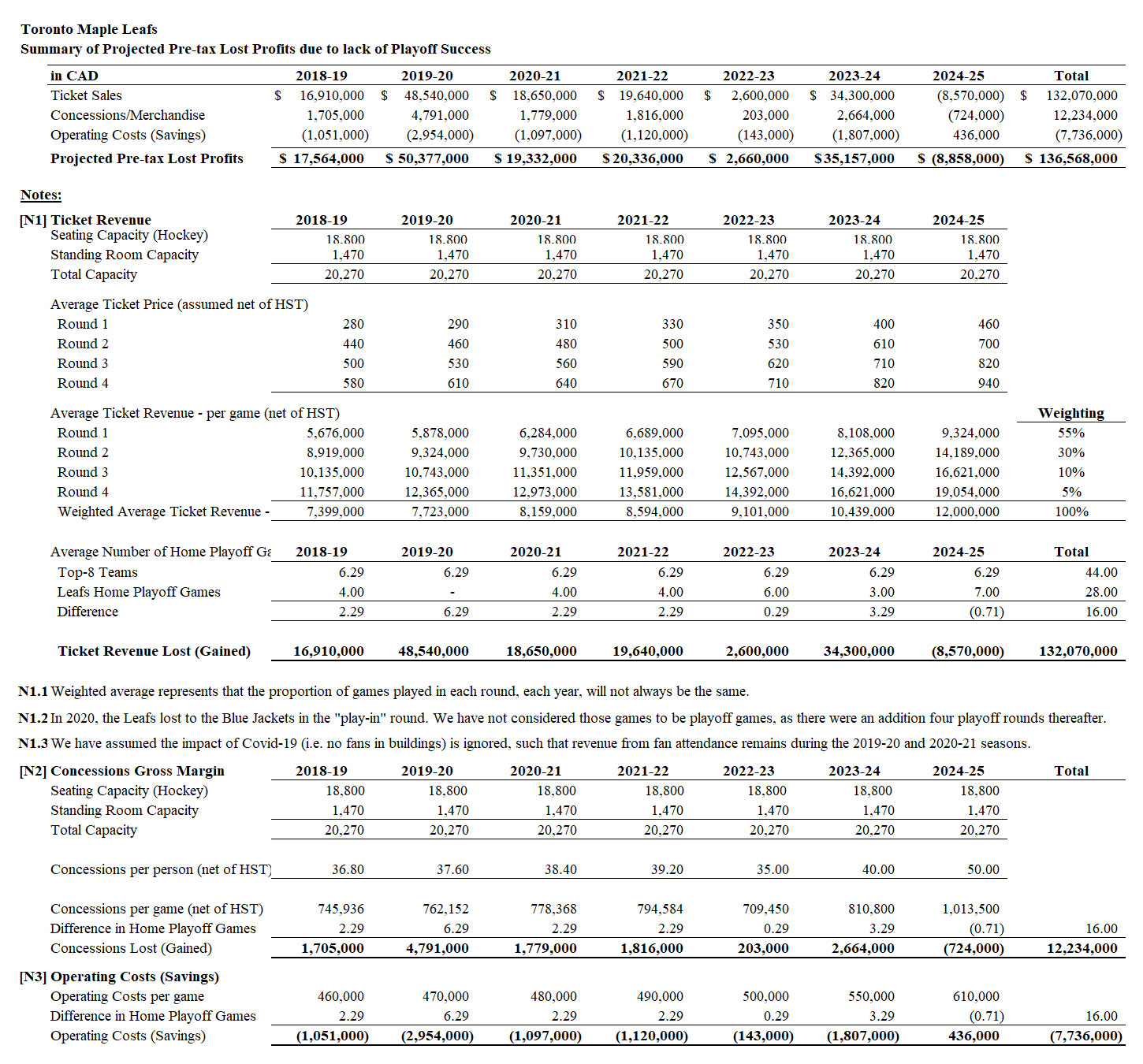
With our assumptions stated, we summarize our calculations and observations, as follows:

- The reduction in pre-tax profit over the course of the 7-year period from 2019 to 2025 was approximately $136.57 million, with an annual average of about $19.51 million.
- Over that period, each missed playoff game would have added an average of about $8.54 million to pre-tax profits.
- In 2025, the Leafs played 7 home playoff games, so there is an $8.86 million reduction in losses, because they exceeded the annual target.
- The losses are the most in 2020 ($50.37 million), when the Leafs lost to the Blue Jackets in the “play-in” round, and thus, did not play in any traditional playoff rounds.
- The losses are reduced to $66.86 million if the Covid-19 years (2020 and 2021) are not included. This is a difference of $69.71 million.
Our calculations are provided below. Here’s hoping that the Leafs can continue to recoup losses in a bigger way going forward. Maybe then, we’ll calculate the cost of a parade!